
Cover Image by Houston Texans
What a wild offseason it has been for the NFL. From teams saying they are going “all in’’ then proceeding to not do anything to the teams who actually did go all in, this offseason has had everything imaginable. Washed up star signing with their former team? Check. Draft day poor decision making by an NFC South team (guaranteed to happen every year)? Check. Franchise players getting traded? Check. Almost the entire 2021 QB class being on different teams? Check. This offseason was crazy, and the Houston Texans had one of the craziest of them all.
Coaches
After an unprecedented season with a rookie HC and QB, the Texans made it a priority to keep together as much of their coaching staff as possible for 2024. While OC Bobby Slowik and QB Coach Jerrod Johnson got interviews for HC and OC jobs respectively, both ultimately stayed. The Texans’ prime opportunity to make a Super Bowl run with a star QB on a rookie contract was one of the main reasons why both coaches decided to stay. The graph below demonstrates just how much value a franchise can get when they hit on their rookie QB. The Texans situation has even more surplus value than other rookie contract star QBs, because C.J. Stroud broke out much earlier in the rookie contract (midway through their first season) than most other similar situations.

Data viz by @KevinCole
The Texans need to make the most out of this upcoming season because both coaches will be even bigger names next offseason. Retaining QB Coach Jerrod Johnson was massive due to his close relationship with Stroud. This partnership fostered the development of the rookie QB last season. Johnson would be the obvious succession plan should OC Bobby Slowik get a head coaching position next offseason.
The Texans were also able to retain other coaches at premium positions, such as DC Matt Burke and Special Teams Coordinator (STC) Frank Ross. The Texans Special Teams has been one of the elite units in football the past couple of seasons, and DC Matt Burke helped Demeco Ryans with game prep and strategy this past season. The graph below shows the Texans efficiency in special teams plays, especially in kickoff coverage and returns.

Data viz by @JackJReinhart
Free Agency
The Texans were BUSY during free agency, especially the first couple of days. Nick Caserio loves giving out short term deals during free agency, and he stuck with his philosophy this cycle as well, just with higher impact players on bigger contracts. Before looking at who the Texans signed, let’s look at who the Texans had to replace. For the purpose of not wasting time, let’s focus on the key contributors from last season. The Texans had to replace:
- Jonathon Greenard, DE, led team with 12.5 sacks and 15 TFL
- Sheldon Rankins, DT, 6 sacks and 9 TFL
- Blake Cashman, LB, led team with 106 tackles
- Steven Nelson, CB, second on team with 4 INT
- Devin Singletary, RB, led team with 898 yards and 4 touchdowns on the ground
- George Fant, OT, filled in admirably for when Laremy Tunsil/Tytus Howard were injured
- Cameron Johnston, P, an above average punter last season
Before the free agency window began, Caserio got to work and re-signed a lot of players. These include:
- Dalton Schultz, TE, 3 year $36m
- Kaimi Fairbairn, K, 3 year $15.9m
- Noah Brown, WR, 1 year $2.6m
- Desmond King, CB, 2 year $7m
- Khalil Davis, DT, 1 year $1.65m
Once the free agency period started, the Texans got to work replacing the production they lost and significantly improving the talent level on the team. Key players the Texans signed were:
- Danielle Hunter, DE, 2 year $49m
- Denico Autry, DT, 2 year $20m
- Azeez Al-Shaair, 3 year $34m
- Jeff Okudah, CB, 1 year $4.75m
- Tommy Townsend, P, 2 year $6m
- Folorunso Fatukasi, DT, 1 year, vet min
Overall, while the Texans lost key contributors from last season, such as Jonathon Greenard, Blake Cashman, and Sheldon Rankins, they were able to replace them with better players at their positions in Danielle Hunter, Azeez Al-Shaair, and Denico Autry respectively. Re-signing key guys like Dalton Schultz, Kaimi Fairbairn, and Noah Brown were under the radar moves that will help keep team continuity strong with all the new faces in the locker room.
Trades
The Texans were super active during free agency, but some of their biggest additions of the offseason occurred via trade. After missing out on the Saquon Barkley sweepstakes and losing Devin Singletary to the Giants on Day 1 of free agency, the Texans pivoted. Nick Caserio saw the Bengals sign Zach Moss in free agency and orchestrated a trade for Joe Mixon, who the Bengals were planning on releasing. The Texans gave up pick #224 which ended up being Daijahn Anthony, a safety from Ole Miss, for Joe Mixon. Caserio would later go on to give Joe Mixon a three year, $27m extension, solidifying Mixon as the Texans’ RB1 for the near future.
A couple of days after trading for Mixon, the Texans traded Maliek Collins to the San Francisco 49ers for pick #232, which Caserio then used in another trade with the Vikings. While this move was initially thought to clear cap space for the Texans to sign DT Arik Armstead, the extra cap space instead helped the Texans open up cap space to trade for another star.
A couple of weeks after free agency began, the Texans traded away their first round pick in the 2024 NFL Draft to the Vikings in what was initially thought to be an interesting move. The Texans traded away picks #23 and #232 to the Vikings for picks #42 and #188, as well as the Viking’s 2025 2nd round pick.

Jersey edit by @designedbyfranco
The Texans then used that Vikings 2025 2nd round pick in a package to acquire star receiver Stefon Diggs (pictured above) from the Buffalo Bills. The Texans traded the Vikings’ 2nd round pick to the Bills in exchange for Stefon Diggs and pick #189, as well as a 2025 5th round pick. When you combine the Diggs deal with the Vikings trade, the Texans essentially moved down 20 spots at the top of the 2024 NFL draft in exchange for Stefon Diggs and a couple Day 3 picks. Trading for Stefon Diggs completed the offense for the Texans, giving them one of the best WR groups in the league with Stefon Diggs, Nico Collins, and Tank Dell. The only confusing part of the Diggs deal was that the Texans restructured Diggs’ contract, making him a free agent in 2025. Unless the Texans re-sign Diggs in the 2025 offseason, they essentially traded what could be a top 50 pick for a one year rental. Obviously, if the Texans win the Super Bowl, it will have all been worth it, but it is still something to think about in regards to the trade.
Draft
Without a first round pick, the first night of the draft was pretty uneventful for the Texans. Nick Caserio confirmed that the Texans tried trading up back to the early 20s (I think it would’ve been for Quinyon Mitchell) but the price was ultimately too high and they stood pat. On day 2, the Texans drafted Kamari Lassiter, a cornerback from Georgia. Lassiter is DAWG, simply put. He is sticky in man coverage and has versatility, showing success in both the nickel and outside corner positions. Lassiter isn’t the fastest, with a 4.5-4.6 second 40 yard dash, but he plays much faster than that when watching his game film. Lassiter should be a versatile player for the Texans who at his peak should be an elite nickel and an above average outside corner, complementing Derek Stingley Jr.
With their own 2nd round pick, the Texans drafted Blake Fisher, a tackle from Notre Dame. Blake Fisher played right tackle for the past two seasons opposite Joe Alt, and at the age of 21 he is one of the younger players in the draft. Fisher should replace George Fant and immediately become the 3rd tackle for the Texans, filling in for either Laremy Tunsil or Tytus Howard should injuries occur. Fisher also has starting potential in the future; many draft experts predicted Fisher to be a top 20 pick in next year’s draft if he had returned to school.
In the 3rd round, the Texans traded up from pick #86 to #78 to draft Calen Bullock, a safety from USC. With such a putrid defense the past couple of seasons at USC, Bullock has been one of the few consistent bright spots. Bullock’s strength is in coverage, where he uses his long length and speed to cover a wide range of the field. Combined with his ball skills, Calen Bullock has the potential to be a ballhawk, causing many turnovers at the next level. His main weakness is tackling due to his thin frame. Ultimately, his skill set fits perfectly with the Texans, as his strengths and weaknesses are the exact opposite of Jalen Pitre; this makes him a perfect fit. He’ll probably be on the depth chart this season with Jimmie Ward returning, but he should be a starter in 2025 once he can fill out his frame.
In the 4th round the Texans traded up once again, moving up from pick #127 to #123 (their original 4th round pick which they traded in the Calen Bullock trade up) to select Cade Stover, a TE from Ohio State. Cade Stover was CJ Stroud’s TE at Ohio State, and with only two years of playing TE, the Texans hope to develop the project player for the future. With Dalton Schultz recently signing a three year contract, Stover won’t be facing immediate pressure to produce, and will be able to work on his game. With vice grip hands and a tenacity unmatched in the run game, Stover has the potential to be an above average TE in the NFL in a couple of seasons.
The rest of the Texans picks occurred in the 6th and 7th rounds of the draft, where they drafted: Jamal Hill, LB from Oregon (#189); Jawhar Jordan, RB from Louisville (#205); Solomon Byrd, DE from USC (#238); Marcus Harris, DT from Auburn (#247); and Ladarius Henderson, OG from Michigan (#249). While none of these players are guaranteed to make the 53 man roster this season, both Jawhar Jordan and Marcus Harris have potential to immediately impact the team this season. Jordan’s vision and decisiveness when making cuts fits perfectly into a run zone scheme, which is what teams like the 49ers and Texans run. With a good training camp Jordan could pass Dameon Pierce on the depth chart as RB2 and contribute by giving Mixon a break during games. Marcus Harris’ quickness and instincts make him a perfect linemen for Demeco Ryans defense. With some polishing and refining of his game Harris could find his way into a rotational role this season.
What I predicted/What the Texans did
In my Houston Texans Offseason Preview, I described the plan and strategy I would have taken for the Texans before free agency began. While I was able to accurately predict some moves they made, the majority of this offseason was incredibly unexpected.
On offense, I knew they needed a RB so I had them sign Saquon Barkley. While they ultimately didn’t end up signing Barkley, the Texans shifted their focus and traded for Joe Mixon. While Mixon isn’t the same caliber of RB as Barkley, he is clearly the Texans’ RB1, as can be seen by the contract extension the Texans gave Mixon. For receivers, I thought they would address the position mainly through the draft, and they did this to an extent. They used some premium draft picks to trade for Stefon Diggs, so I’ll give myself half a point for that. However, I did accurately predict that they would resign Noah Brown. I also accurately predicted that the Texans would resign Dalton Schultz. In the mock draft I included in the offseason preview, I predicted Cade Stover to the Texans at the exact pick where they got him, pick #123.
On defense, I thought the Texans would re-sign Greenard; instead they upgraded at the position, signing Danielle Hunter. While Hunter is older than Greenard, he stays on the field more often and had better sack production last season. Having Hunter on one edge and Will Anderson Jr on the other prevents opposing offenses from double teaming Anderson Jr as they did so often last season. I predicted that the Texans would re-sign Blake Cashman as well, and they instead upgraded in this position too, signing Azeez Al-Shaair. Edgerrin Cooper was a draft crush of mine, but after investing in Al-Shaair, the Texans had more pressing needs in other areas that prevented them from drafting a LB in the first few rounds. To replace Steven Nelson as the team’s CB2, I predicted that the Texans would sign a lower tier corner in free agency (Jeff Okudah). Finally, the Texans upgraded their safety depth through the draft, another area of need I predicted they would address relatively early in the draft.
In the end, while I predicted some minor signings and draft picks for the Texans, I was pleasantly surprised with Caserio’s aggressiveness in free agency and in the trade market. He fully took advantage of Stroud’s rookie scale contract to build a Super Bowl contender for 2024 and beyond.
Jerseys
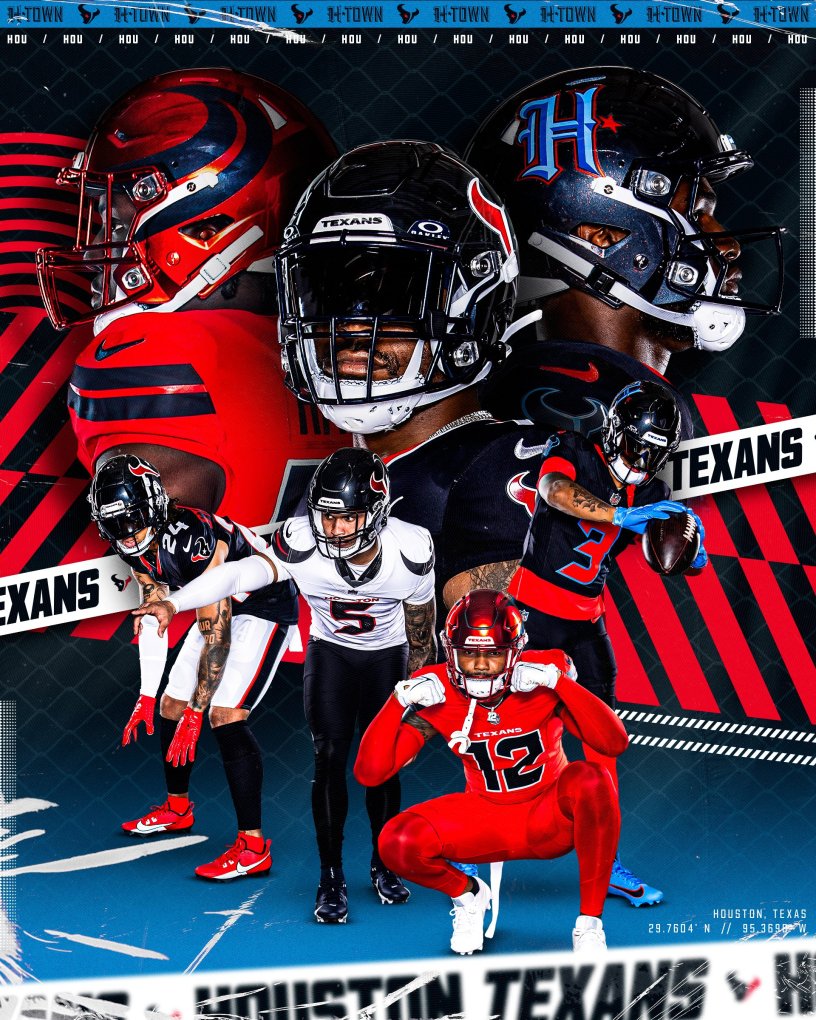
The Texans also released new jerseys for the team, symbolic of the new change in leadership in the organization for the upcoming future. In my opinion, these new jerseys are significant upgrades over their old jerseys and should make the team ‘pop’ on the field this upcoming season. The jerseys on the left side are the old ones, and the jerseys on the right side are the new ones the Texans will be showcasing this upcoming season.

My particular favorites are the two new alternate jerseys: the ‘Battle Red’ and the ‘H-Town Blue’ uniforms (the bottom two jerseys from the graphic above). These jerseys provide a different look for the Texans; when combined with their unique helmets really make the players look intimidating.
2024 Record Prediction
While the official schedule for the Texans has not been released yet, we do know which opponents they will be facing this season.

Assuming none of the Texans’ premier players suffer any significant injuries, I predict the Texans to win 6 out of their 8 home games. I think they lose to the Ravens and Lions, but beat the Bills, Dolphins, Bears, Colts, Jaguars, and Titans. For their road games, I predict the Texans to win 7 out of 9 games. I think they lose to one of their AFC South opponents and to the Packers in Lambeau Field, especially if the game is later in the year when the Packers thrive. I have them beating the other two AFC South opponents, as well as the Patriots, Jets, Chiefs, Cowboys, and Vikings.
Overall, I predict the Texans to finish the 2024 regular season with a 13-4 record, good enough for 2nd place in the AFC playoff picture. I think the Texans will make the AFC Championship game, and I like their odds of representing the AFC in the Super Bowl. This season should be an exciting one for the Texans, and this season has the potential to be the most successful and most memorable in franchise history.
 M-FANS