
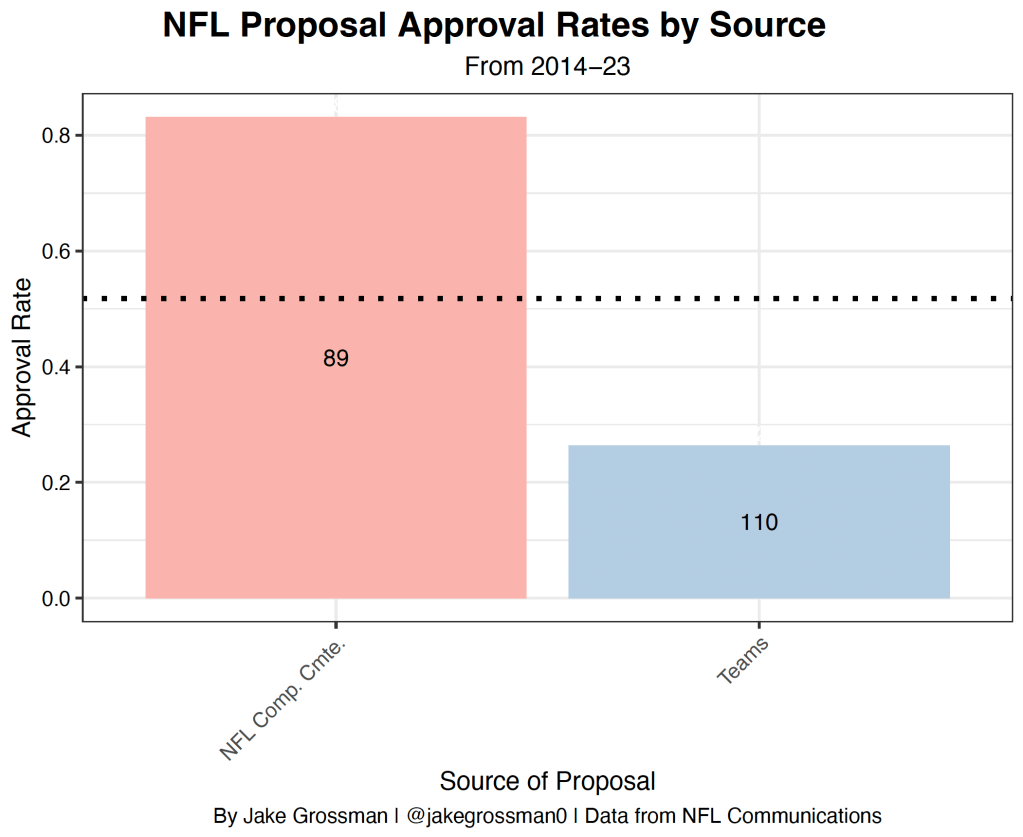
In light of the submission of rule change proposals for the 2024 NFL League Meetings by teams, I decided to review how often these proposals have historically passed. Each year, NFL teams submit various proposals to improve the game. These proposals fall in three categories: playing rules, bylaws, and resolutions. In order to be passed, a proposal must be approved by 75% (24/32) of the league’s owners. From 2014-2023, there were 199 proposals from teams across the league and/or the NFL Competition Committee.1 Just over half (51.8%) of these were actually able to gain enough support among ownership to pass.
The most relevant factor in determining a proposal’s likelihood of passing is its origin. Rule changes proposed by the Competition Committee have a higher likelihood of passing. Of their 89 proposals over the past 10 years, 74 (83.1%) have been approved by NFL ownership. On the other hand, NFL teams have not had nearly the same success, sporting an approval rate of just 26.4%. Therefore, although reviewing these team proposals will be interesting, they are less likely to pass compared to those coming from the Competition Committee next week.
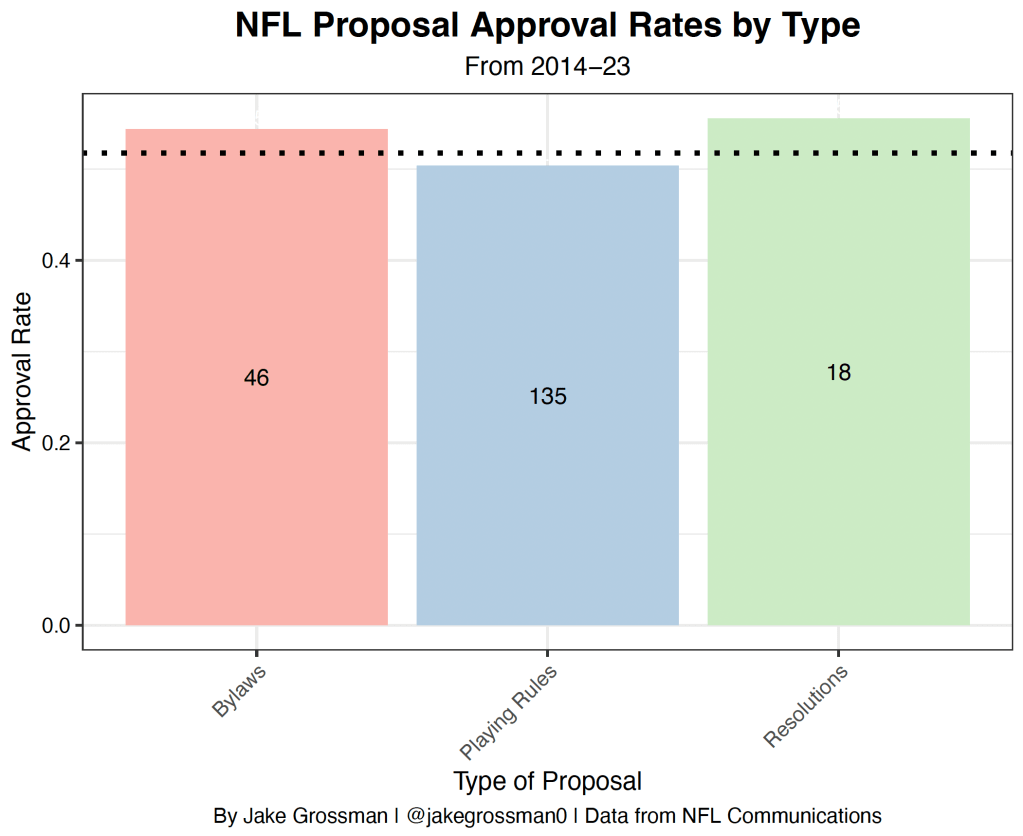
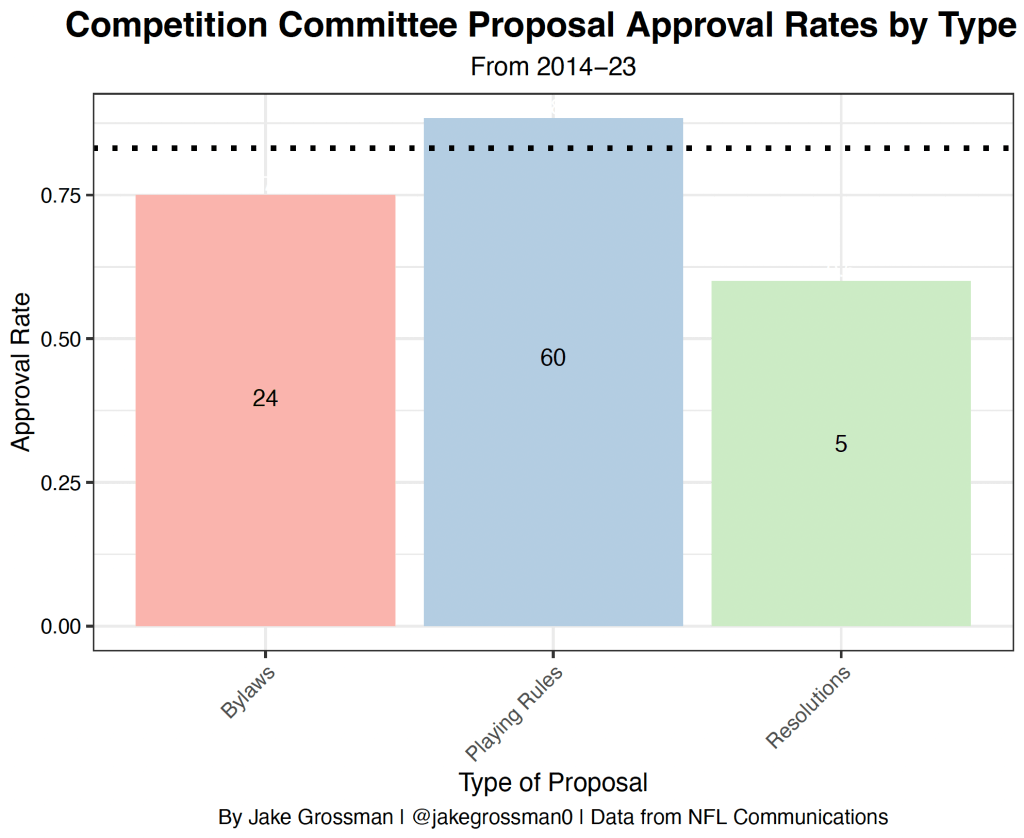
The success rate remains consistent across different types of proposals, whether they are for playing rules changes, bylaw amendments, or resolutions. Here are the overall approval rates by category:
However, examining this data alongside the origin of the proposals reveals the impact of proposal type, despite concerns regarding sample size. The data, visualized in the plots below, shows that individual teams have higher success rates in amending bylaws (31.8%) and passing resolutions (53.8%) compared to their proposals on playing rules, where only 20% achieved the required 24 votes for approval.
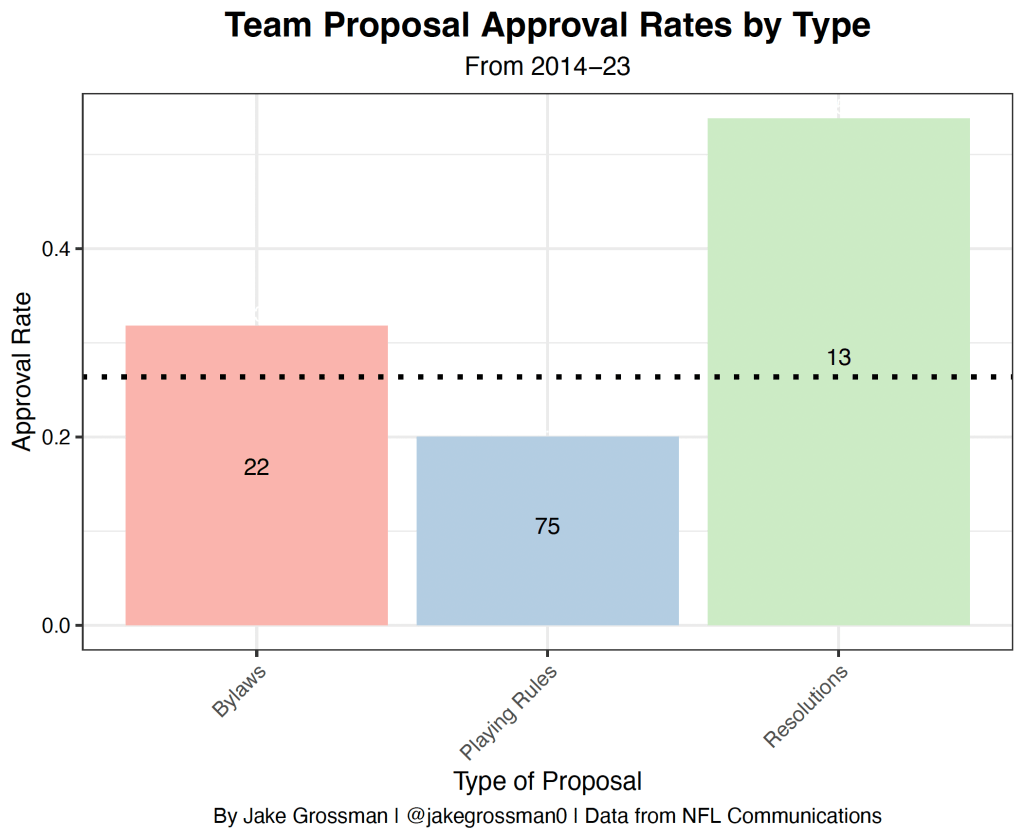
The NFL Competition Committee’s mission is to consult with teams across the NFL to gather their insights on how to best evolve the rules of NFL football. Thus, it’s unsurprising that the committee’s proposed rule changes are readily passed by the league. An additional factor contributing to their success is the inherent nature of committees to require compromise, which naturally filters out the more unconventional proposals. It’s also noteworthy (though on a tiny sample) that the significant disparity in approval rates between team and committee proposals diminishes when it comes to resolutions.
Data also indicates that multi-team proposals do not significantly boost success rates, evidenced by a 25% approval rate (3 out of 12). This falls below that of individual team proposals. This detail gains relevance against the backdrop of this year’s trade deadline proposals. The Steelers’ solo proposal to move the trade deadline to Week 9 is juxtaposed with a collective proposal by Cleveland, Detroit, the New York Jets, Philadelphia, San Francisco, and Washington, aiming for Week 10. The larger group’s numerical superiority may not guarantee success due to the reasons previously mentioned, alongside the possibility of Week 9 serving as a viable compromise for teams on the fence. This adjustment might also be more compellingly presented as a response to the 17-game season. Observing whether the Competition Committee aligns with either stance, or introduces an alternative, will be intriguing.
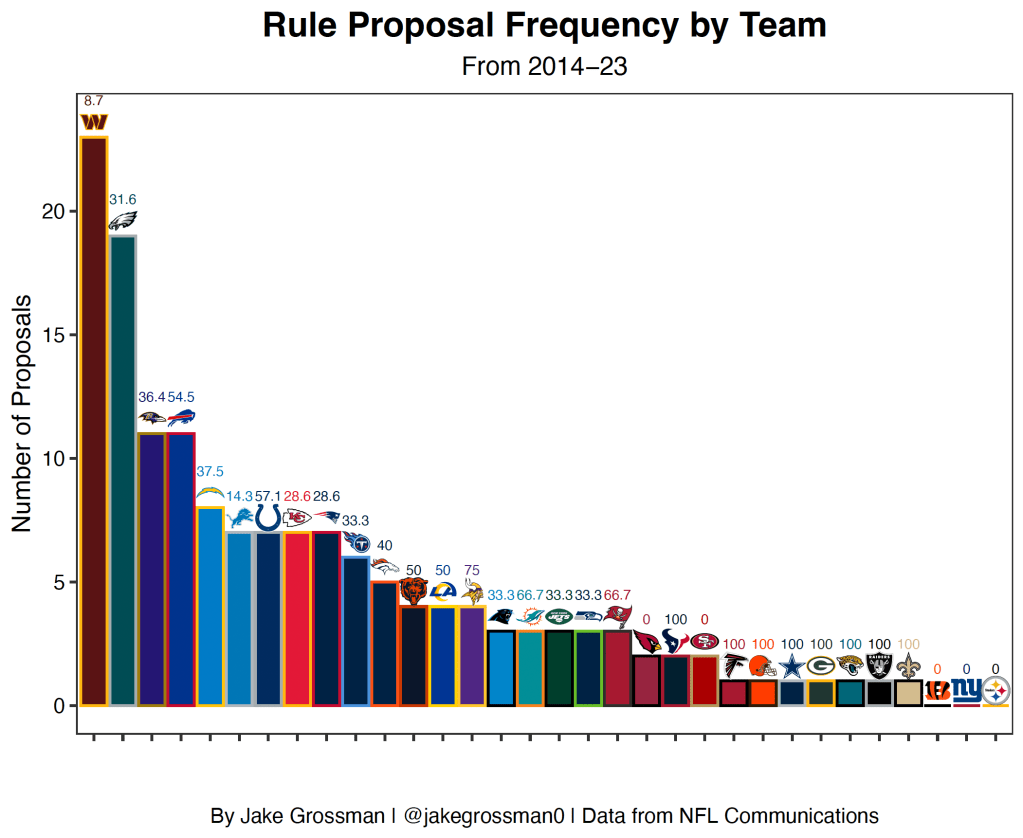
Lastly, examining each team’s proposal frequency and success reveals notable patterns. The Cincinnati Bengals, New York Giants and Pittsburgh Steelers, interestingly, had submitted zero proposals before this off-season. The reason for this becomes clearer with additional context. John Mara has been a member of the Competition Committee for 15 years and chairs the NFL Management Council Executive Committee. Mike Tomlin has also been on the committee since 2013. While the Bengals haven’t always had committee representation, former head coach Marvin Lewis served from 2006 to 2018, and executive vice-president Katie Blackburn joined in 2022. It seems these teams, understanding the legislative process, presume that proposals unlikely to pass committee scrutiny may not be worth presenting to the broader voting body.
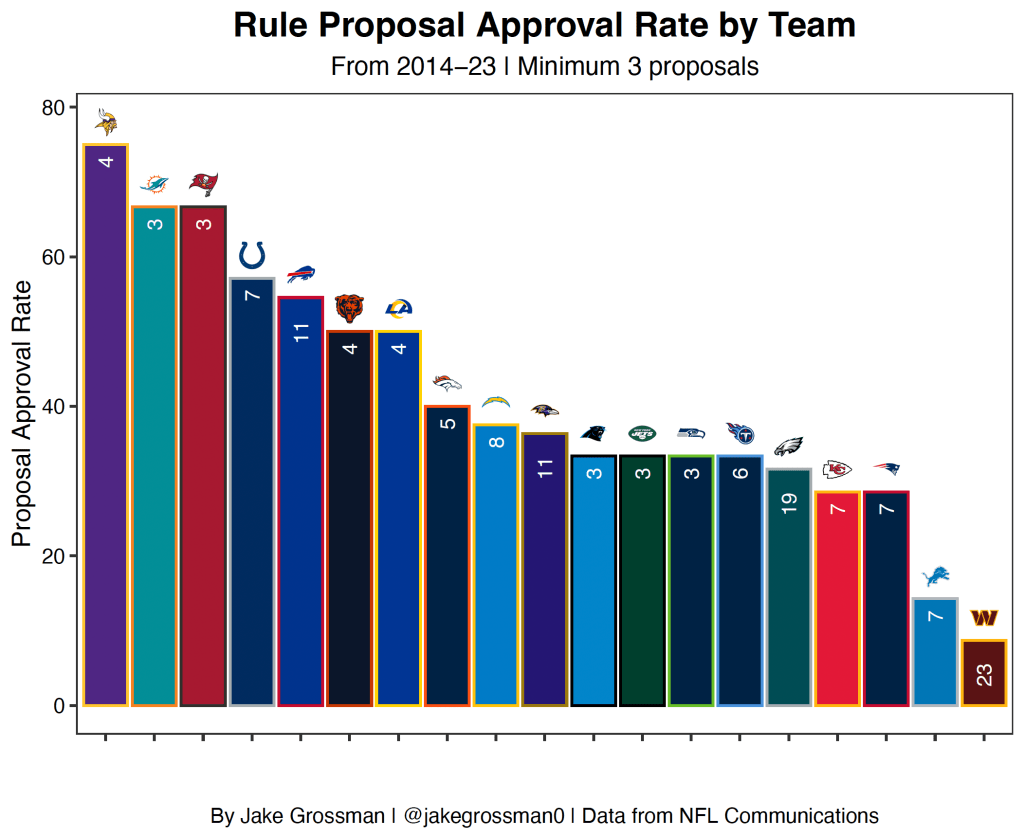
While the specific approval rates of each team’s proposals, as illustrated in the plot below, may not yield significant insights, they offer a fascinating glimpse into how various teams have fared during league meetings. The Commanders, notably, have submitted more rule proposals than any other franchise yet exhibit the lowest success rate among teams with at least three proposals. Conversely, both the Bills and the Colts have managed to successfully pass several of their proposals.
Here are the summaries of the club proposals for 2024 from NFL Communications. While many of these might not pass this year, they often pave the way for future proposals. Many rule changes, from the new playoff overtime to the expanded instant replay system, come from previous proposals that did not gain enough support to reach adoption. Furthermore, many rules come in trial periods and must prove successful before being permanently inscribed into the rulebook. This iterative process ensures that the NFL continuously evolves, adapting to the demands of the game and its audience.
2024 Playing Rule Proposals Summary
- By Detroit; amends Rule 15, Section 1, Article 1, to protect a club’s ability to challenge a third ruling following one successful challenge.
- By Philadelphia; amends Rule 9, Section 2, Article 2, to eliminate the first touch spot after the receiving team possesses the ball.
- By Philadelphia; amends Rule 6, Section 1, Article 1, to permit a team to maintain possession of the ball after a score by substituting one offensive play (4th and 20 from the kicking team’s 20-yard line) for an onside kickoff attempt.
- By Indianapolis; amends Rule 15, Section 3, to permit a coach or replay official (inside of two minutes) to challenge any foul that has been called.
2024 Bylaw Proposals Summary
- By Detroit; amends Article XVII, Section 17.16 (C) of the Constitution & Bylaws, to remove the requirement that a player must spend at least one day on the Active roster following the final roster reduction in order to become eligible to be designated for return.
- By Detroit; amends Article XVII, Section 17.16 (C) of the Constitution & Bylaws, to provide clubs with an unlimited number of designated for return transactions in the postseason.
- By Buffalo; amends Article XVII, Section 17.3 of the Constitution & Bylaws, to expand the Standard Elevation rules to permit clubs to elevate a third player from its practice squad who is a bona fide quarterback to be an Emergency Third Quarterback.
- By Pittsburgh; amends Article XVI, Section 16.6 of the Constitution & Bylaws, to move the trading deadline to the Tuesday after Week 9 games.
- By Cleveland, Detroit, New York Jets, Philadelphia, San Francisco, and Washington; amends Article XVI, Section 16.6 of the Constitution & Bylaws, to move the trading deadline to the Tuesday after Week 10 games.
2024 Resolution Proposals Summary
G-1. By Buffalo; to make the injury reporting rules for players who do not travel with their clubs to games away from their home city competitively fairer. G-2. By Jacksonville; to make available the “working box” Hawk-Eye replay feed in the coaches booth. G-3. By Philadelphia; to require game clocks to display tenths of seconds for the final 60 seconds of each half.
- Data Note: The 199 proposals identified from 2014 to 2023 may not represent every rule proposal made during this period. NFL teams can propose rules directly on the voting floor, which means some proposals may not be included in the initial count. Additionally, information on the approval status of a few proposals from 2014 and 2015 was unavailable in public records. It’s also worth noting that proposals from other entities within the NFL governance structure, such as the NFL League Office or the Health and Safety Committee, were excluded from this analysis. ↩︎
 M-FANS