
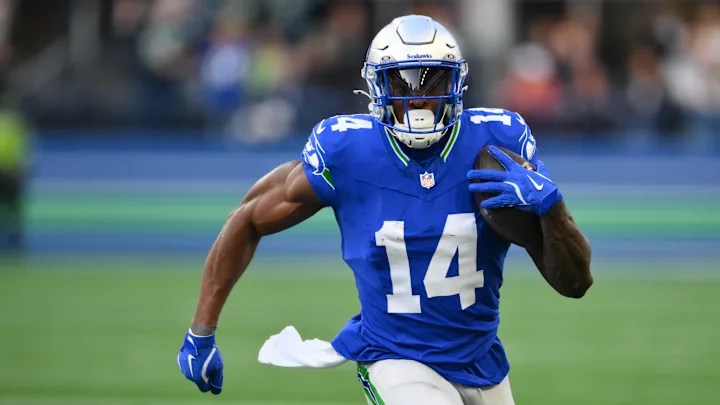
Steven Bisig-Imagn Image
Recently, our members participated in our club’s annual Mock Free Agency, where our members each navigated their team(s) through the unpredictable waters of the NFL offseason. Through signings, re-signings, cuts, trades, and restructures, our members worked to create an accurate simulation that in some ways mimics real-life dealings and in other ways differs. In the end, our members learned through this immersive experience the limitations and motivations of NFL general managers and front offices. Below is a short excerpt from 16 of our highest-spending general managers about their teams’ moves and rationales.
49ers: Robel Daniel, Undergraduate – Business
Riddled with injuries, 2024 was a season to forget for San Francisco, who now find themselves potentially outside of their Super Bowl window. The 49ers began by trading Deebo Samuel to the Commanders in exchange for a 2025 5th round pick, acquiring draft capital and freeing up future cap space by getting Samuel’s contract off the books. They then released veterans Leonard Floyd and Kyle Juszczyk and restructured the contracts of George Kittle and Fred Warner to clear up cap space. San Francisco brought back linebacker Dre Greenlaw on a 3-year $39 million contract ($13M APY) and re-signed depth players Kevin Givens, Ben Bartch, Patrick Taylor, Jordan Mason, and Curtis Robinson. In free agency, they addressed their needs in the secondary after losing Talanoa Hufanga and Charvarious Ward by adding Nate Hobbs for 4-years $40 million ($10M APY) and Paulson Adebo for 3-years $32 million ($10.67M APY). The two 25 year olds will be contributors for years to come and create a formidable secondary in San Francisco. They confronted their interior offensive line woes after losing guard Aaron Banks by signing Ryan Kelly for 2-years $18 million ($9M APY) and Dalton Risner for 1-year $6M. This free agency, the 49ers got younger defensively and addressed their needs on the offensive line while positioning themselves to extend Brock Purdy on a multi-year deal.
Bears: Jonathan Manela, Undergraduate – Statistics
With cap space toward the larger end of the league, the Bears were willing to make a splash – and splash they did. Their main priority was to bolster the front seven with an edge rusher, and for an AAV of 27.75 million, they brought in Josh Sweat, a wondrous complement to his brother Montez Sweat, already on the D-Line for Chicago. The next order of business was bringing in a power back to complement D’andre Swift’s elusivity. After falling short in search for more traditional power backs, the Bears brought in Kyle Juszczyk with a 5.5 million AAV. Although a traditional fullback rather than a modern powerback, he brings in some backfield brawn to complement Swift’s speed. The next priority was ensuring the safety of Caleb Williams before his sophomore year, and that was done through signing Josh Myers to an 11 million AAV deal. After the disastrous performance by Keenan Allen, a new weapon was in order at wideout, and Tim Patrick’s heroics gave him a 7.5 million AAV deal. The last deal made by the Bears strengthened the trenches even more, bringing in veteran presence Calais Campbell on a 9.5 million AAV deal to play alongside, and mentor, the young defense.
Browns: Jake Grossman (@jakegrossman0), Graduate – Law
The Browns are in a tight spot. Deshaun Watson will likely not play this season after tearing his Achilles in Week 7 of last season. Still, it is necessary to restructure his contract to create adequate room to field a viable team this year. Because of their spending tendencies, it would be surprising for the Browns to fold and not make an attempt at being competitive. With the Falcons holding onto Kirk Cousins and the bridge QB market getting expensive, the best course of action was to trade two 2025 draft picks (Round 4 pick (104) and Round 6 pick (200)) for Joe Milton.
Giving a boom-or-bust option like Milton 17 games to show whether he can be a quarterback the team can build around strikes me as the right approach—since he offers enough upside to be intriguing, and enough downside to leave the team well-positioned for the 2026 draft.
After releasing Nyheim Hines and Charley Hughlett to create some more cap room, the team re-signed Nick Chubb (Four Year Qualifying Offer), Elijah Moore (1 yr, $3.5m), and Jedrick Wills (1 year, $4.5m). Then, after restructuring Myles Garrett, Denzel Ward, Ethan Pocic, Wyatt Teller, Jordan Hicks, Grant Delpit, Jack Conklin, and Joel Bitonio, the Browns loaded up on defense in hopes of building a dominant unit like they had two years ago.
Signings included Haason Reddick (1 yr, $12m), Von Miller (1 yr, $7m with incentives up to $15m), Teair Tart (1 yr, $4m), and Jason Pinnock (1 yr, $2.2m). The Browns also added JK Dobbins for 2 years at a $3.5m APY with $3m in total guarantees and Diontae Johnson at $3m for 1 year. Finally, the Browns picked up two players who were cut by the Dolphins— Durham Smythe (1 yr, $1.5m) and Kendall Fuller (1 yr, $3m). Many of these players could become trade deadline chips if the season goes south, but these signings give Jim Schwartz and the defense the tools they need to rebound while the offense figures itself out for another year.
Buccaneers: Jack Reinhart (@JackJReinhart), Undergraduate – Economics
Tampa Bay has found their quarterback and the team was extremely competitive last year before injuries took over. This year may be one of the last chances for a team who will be losing the last of its core veterans like Mike Evans or Lavonte David to retirement in the near future. It is because of these reasons that it is time to go all in.
The Buccaneers began free agency by restructuring the contracts of Baker Mayfield, Tristan Wirfs, Mike Evans, Vita Vea, and Antoine Winfield Jr. The team also cut Jordan Whitehead to free up more cap space. Before making big splashes in free agency, the Buccaneers brought back Chris Godwin on a 3-year, $81 million ($27 million APY) deal with $54 million guaranteed and Ben Bredeson on a 3-year, $22 million ($7.3 million APY) deal. Bringing back these two key offensive players will help the Bucs maintain their high-powered offense from 2024. In the open market, the Bucs were not shy. First, they found their replacement for Lavonte David in Super Bowl Champion, Zack Baun. The Bucs outbid multiple other teams with a 2-year, $32 million ($16 million APY) deal. The true bidding war came with DJ Reed, when the Bucs landed the top corner of the free agency class with a 2-year, $52 million ($26 million APY) contract. The Bucs added more defensive depth by signing Devin Bush to a 1-year, $7 million contract that will yield high returns for not too large of a financial commitment. Finally, Tampa capped its free agency by signing Justin Simmons to a 1-year, $8 million deal to complement free safety, Antoine Winfield, as the team’s strong safety. The Buccaneers’ window may be closing, but an aggressive free agency propped it open for at least another season.
Cardinals: Ethan Watson, Undergraduate – Business
After faltering down the stretch last season, Arizona was looking for help in the trenches on both sides of the ball. The Cardinals started by resigning Evan Brown for 2-year, 12 million (6 APY) and Kelvin Beachum for 1-year, 8 million to bolster offensive line depth. Arizona was active in free agency, signing defensive tackle Tershawn Wharton to a 2-year, 32 million deal (16 APY) to strengthen the defensive line and replace Khryis Tonga, who they decided to let test free agency. Continuing on defense, the Cardinals were interested in Josh Sweat, but did not want to pay him about 25 million a year, and instead took a chance on defensive end Dayo Odenyibgo on a 3-year, 40 million deal (13.33 APY) and also signed linebacker Jamien Sherwood for 3 years, 45 million (15 APY) deal. After deciding the defense was fortified, the Cardinals signed guard Patrick Mekari for 3-years, 38.5 million (12.83 APY) and reunited with wide reciever DeAndre Hopkins on a 1-year, 7.5 million deal. Arizona is hoping their improvements in the trenches will finally lead to a breakthrough in a weak NFC west.
Colts: Jake Grossman (@jakegrossman0), Graduate – Law
The Colts are in a pivotal year that will determine the franchise’s direction. The goal is to give Anthony Richardson the opportunity to continue developing, but it only makes sense to bring in a veteran backup in case his struggles passing the ball persist. While the team was set to lose a couple of key free agents (Will Fries, Ryan Kelly, and Dayo Odeyingbo) to contracts larger than they were comfortable paying, this did not mean the Colts were going to simply watch their roster decline.
After restructuring the contracts of Michael Pittman Jr., DeForest Buckner, and Quenton Nelson, the team had plenty of room to target free agents to fill several holes on the roster. The secondary was completely revamped with signings of Cam Bynum (4 years, $15m APY), Rasul Douglas (2 years, $12m APY), Stephon Gilmore (1 year, $6m), and Isaiah Simmons (1 year, $1.5m). The team continued focusing on impact defenders by signing Lavonte David (1 year, $8m), Michael Hoecht (3 years, $6.5m APY), and Josh Uche (1 year, $2m).
On the offensive side, Daniel Jones was brought in as a backup QB on a 1-year, $9m deal, with incentives that could increase the value if he plays significant snaps. The team also added Matt Pryor (1 year, $5.5m) to compete for the right guard spot, while Khalil Herbert was signed to back up Jonathan Taylor at running back. The Colts should be comfortable starting Tanor Bortolini at center next season after he showed promise last season.
Finally, the Colts released Matt Gay, freeing up $2.75m in cap space to replace him with free agent kicker Austin Seibert. With a stronger defense and continued development from Anthony Richardson and the other young offensive players, the Colts could be a dark-horse team to watch in the AFC next season.
Cowboys: Don Weismiller, Graduate – Public Policy
We needed to make more cap space, so restructuring Dak Prescott and Ceedee Lamb was a must to get to 53 million in cap. The biggest priority was resigning Osa Odighizuwa. Dallas has a strong need for defensive tackles since Mazi Smith isn’t quite living up to expectations. Osa at 3 years for 75 million. A deal close to the real one. Signing Markquese Bell was one of the few resignings I agreed with. 9 mil for 3 years seems reasonable for a quality safety. Knowing I have to extend Micah Parsons with a new deal was looming over my decision making. I tried to get a veteran receiver, but was out bidded on Tyler Lockett and Stefon Diggs. My biggest regret was not getting Diggs, but I wasn’t willing to pay more than 15 mil per season on a receiver on the wrong side of 30. In hindsight, I should have gotten a deal done with Parsons before Garrett and Crosby got their deal. FA would have gone better had I known how much money I had to resign my best player.
Eagles: Jake Grossman (@jakegrossman0), Graduate – Law
The Eagles did not have the cap space required to re-sign any of the key free agents—Milton Williams, Josh Sweat, Zack Baun, and Mekhi Becton—they were set to lose this offseason. While in a real-world scenario cap hits in year one could have been manipulated through contract structures, that was not an option here because we used each player’s contract’s average annual value (APY) as their year one cap hit. As a result, the next best strategy was to wait out free agency and sign players who would not affect the compensatory draft picks earned from the departures of these star players.
Once that window opened, the Eagles began filling the roster holes left by those losses. Robert Spillane was signed to a 2-year deal at $7 million APY to replace Zack Baun. Josh Sweat was replaced in the aggregate through discount signings of Matthew Judon (1 year, $3m with incentives) and Dennis Gardeck (1 year, $2.5m). Meanwhile, the hole in the middle of the defensive line left by Milton Williams was addressed by bringing in Javon Kinlaw (3 years, $7m APY), though the Eagles were already more than equipped to handle that departure due to their depth on the interior. Kenneth Gainwell’s spot was filled by Rico Dowdle (1 year, $2.5m). Due to the inflated guard market, the Eagles will have to replace Mekhi Becton with either Tyler Steen or a draft pick.
Darius Slay and James Bradberry were released, and the Eagles will also look for more secondary depth in the draft behind their young stars. Replacements on the defensive line will likely be the Eagles’ focus on Days 1 and 2 of the NFL draft. While it was impossible to retain the entire Super Bowl-winning roster, this group is likely still the most talented in the NFL.
Falcons: Rohan Patel (@rpat_57), Undergraduate – Data Science, Computer Science
The biggest need for the Falcons going into the offseason was clearly adding talent to the defense. More specifically, the Falcons desperately needed an edge rusher and a corner. Baron Browning will provide serious help off the edge, and Mike Hilton will boost the Falcons secondary tremendously. Both players boost positions of need, and also opens up the potential draft options, allowing them to take the best player available as opposed to reaching for needs. The Falcons could use another outside weapon for Michael Penix or keep bolstering the defense in the draft.
Giants: Robel Daniel, Undergraduate – Business
Following a disastrous 3-14 season, the Giants enter this offseason in need of help on both sides of the ball. They began by securing their quarterback, trading a 2025 3rd and 2026 5th to Seattle for Geno Smith. They then released Graham Gano and Rakeem Nunez-Roches and restructured the contracts of Andrew Thomas, Brian Burns, and Dexter Lawrence to free up cap space. The Giants re-signed Darius Slayton on a 3-year $36 million deal, keeping hold of their veteran outside receiver opposite Malik Nabers. They also brought back starting punter Jamie Gillan and depth pieces Chris Manhertz, Ihmir Smith-Marsette, Tomon Fox, Casey Kreiter, and Tommy Devito. To start free agency, the Giants signed Asante Samuel on a 3-year $37.5 million contract ($12.5M APY), adding necessary help at corner alongside Dru Phillips and Deonte Banks. The G-men then shored up their interior offensive line, signing James Daniels to a 3-year $32 million deal ($10.67M APY). The Giants dipped back into the secondary, signing Andre Cisco for $20 million over 2 years ($10M APY), adding a complement to Tyler Nubin following a promising rookie year. Finally, the Giants targeted defensive line depth by adding defensive tackle Roy Lopez on a 1-year $4 million contract, strengthening what was a poor run defense with a quality run defender. The Giants prioritized remaining young in free agency, with none of their new additions exceeding 27 years old. They were able to secure a quarterback capable of leading a successful offense and addressed needs across the roster. Possessing the 3rd pick in the draft, the Giants could find themselves back in the playoffs sooner than many expect.
Jaguars: Devin Wiles (@DevinWiles22), Undergraduate – Business
After allowing the fifth-most points and second-most yards of any team in 2024, the Jaguars entered free agency in search of defensive assets. Though the offense didn’t rank much better (26th and 24th, respectively), a potentially strong running back duo paired with Trevor Lawrence and Brian Thomas Jr. for years to come profiles as an area where the team is sure to grow. The hefty cap hits of Evan Engram ($19.5M) and Christian Kirk ($24.5M), however, were hindering Jacksonville from making meaningful additions on the defensive side of the ball. My first choice was to cut these two in favor of clearing up some space. In doing so, I looked to add, first and foremost, in the secondary and then in the interior defensive line. Early bids for Charvarius Ward and Milton Williams ($25 and $26M AAV, respectively) were hefty in our free agency simulation, however, and encouraged me to take a more patient approach. In the end, I chose to splurge on Talanoa Hufanga and BJ Hill at the two positions, hoping to pull some of the value Hufanga had earlier in his career (2022 Pro Bowler with San Francisco) back out while hoping to rely on the consistency of Hill up the middle. I am of the belief that Hufanga could reclaim something in Jacksonville alongside Darnell Savage. With a core of Travon Walker, Josh Hines-Allen, Foyesade Oluokun, and BJ Hill in the front lines, the Jags should be able to apply pressure and stop the run at a strong rate. The contracts for Hufanga and Hill tallied up to three-years, $36M and three-years, $33M, respectively. After re-signing Brandon Scherff on a one-year deal and adding Mo Alie-Cox for a year as a blocking option to complement receiving tight end Brenton Strange, the Jaguars should be in a place to win a few more games in 2025. Nonetheless, the draft is where Jacksonville will truly craft its future and develop a plan to get on track and play in the postseason. Main positions of need would include wide receiver and defensive back.
Lions: Jack Reinhart (@JackJReinhart), Undergraduate – Economics
After a brutal end to a season defined by injuries, the Lions and their fans were left hungry for more. 2025 is one of the final seasons before some of Detroit’s star ‘young guns’ remain on their rookie contracts. The time to go all in is now. Detroit began free agency by restructuring the contracts of Jared Goff, DJ Reader, and Taylor Decker; this freed-up a little over $31 million in cap space. Before hitting the open market, the Lions re-signed Derrick Barnes (3-year, $24 million, $8million APY), Ifeatu Melifonwu (2-year, $4 million, $2 million APY), and Carlton Davis (3-year, $57 million, $19 million APY) in order to sure up one of the best defenses in the league when healthy. After failing to strike a deal with Kevin Zeitler before free agency opened, the Lions made sure to find his replacement early by giving Will Fries a 2-year, $39 million ($19.5 million APY) contract. Though the Lions are excited to use Christian Mahogany more this year, the interior offensive line has been very prone to injuries in the last few years, so Detroit viewed this as a necessary move. While Tim Patrick was loved in Detroit, the team chose to go another direction in finding their ‘Y’ wide receiver in Josh Palmer. The team gave the former Charger a 2-year, $30 million ($15 million APY) contract after getting into a bidding war with multiple other teams. Palmer has shown flashes of greatness and he is exactly the type of player the Lions need on the outside. Finally, the team added some depth to the interior defensive line after the departure of Levi Onwuzurike by signing Sheldon Rankins to a 1-year, $8 million contract. The Lions were a Super Bowl contender before injuries got in the way last year; now, they are reloaded and have the opportunity to make history in 2025.
Saints: Jake Grossman (@jakegrossman0), Graduate – Law
Welcome to hell. The Saints are basically the latter half of this once-viral tweet at the moment:
They once dared to play God, these Saints—parting the salary-cap sea, piling covenant upon covenant in their quest for championship glory. But as any scripture might warn, such acts rarely go unpunished. Now, cast out of the promised land of flexibility, they wander through a cap-wilderness of their own creation, resigned to atone for the bold, almost heretical ambitions that brought them here. The fate they forged with their own hands has finally come calling, and there is no higher power that can deliver them from this penance.
Loomis and co. saw how talented their legendary 2017 draft class was, recognized that they had an aging but still highly-talented Hall of Fame bound quarterback in Drew Brees, and somewhat reasonably pushed all their chips into the middle of the table. He got results. Between the years of 2016 and 2021, the Saints put up two of the five best runs ever by DVOA over a 5-year stretch by a team that did not reach a Super Bowl.
However, like those who once endeavored to build a tower to the heavens, the Saints’ unyielding ambition overshadowed their humility. In turn, divine judgment struck them down through the improbable Minneapolis Miracle and a fateful pass interference no-call. A righteous penalty for hubris that dared to upset the natural order.
All that can be done in this exercise is mimic the real-life extensions and restructures of the team. Because cap hits are equal to APY, there is very little flexibility to structure deals in a way that allows the Saints to build the roster. After restructuring or renegotiating the contracts of Derek Carr, Cesar Ruiz, Carl Granderson, Khalen Saunders, Cedrick Wilson, Cam Jordan, Tyrann Mathieu, Eric McCoy, and Demario Davis, there was sufficient cap space to retain Chase Young (3 years, $17m APY) and Juwan Johnson (3 years, $10m APY). While this would not be the most inspiring offseason, this fate was chosen long ago.
Seahawks: Ethan Watson, Undergraduate – Business
Following a disappointing end to first-year head coach Mike Macdonald’s first season, Seattle realized that they needed a retool on offense to remain competitive. Before free agency, Seattle was active, re-singing linebacker Ernest Jones IV to a 3 year, 33 million (APY) and defensive tackle Jarran Reed to a 3-year, 18 million (6 APY) to strengthen the defense and continue the turnaround that happened in the second half of last season. Despite being negative in cap space, Seattle was able to create almost 74 million in cap space by releasing Rayshawn Jenkins, Roy Robertson-Harris, Dre’Mont Jones, Tyler Lockett, and George Fant as well as restructuring the contracts of Leonard Williams and Uchenna Nwosu. Seattle was also active in the trade market, deciding to trade quarterback Geno Smith to the New York Giants for a 2025 3rd round pick and a 2026 fifth round pick, as well as wide receiver D.K. Metcalf to the Kansas City Chiefs for offensive guard Joe Thuney and a 2025 3rd round pick. Seattle knew they had to address the offensive line even with the Joe Thuney trade, and ended up signing offensive guard Aaron Banks on a 2-year, 30 million (15 APY) deal, giving them a new configuration up front, and promise for a group that struggled in 2024. Seattle also signed the top quarterback in the free agency class, Sam Darnold, on a 3-year, 100.5 million deal (33.5 APY) to complete this new-look offense that focused on a zone run and play-action scheme under offensive coordinator Klint Kubiak. Seattle completed the offseason by signing cornerback Brandon Stephens to a 1-year, 8 million fully guaranteed deal, hoping Stephens could replicate his performance from 2023, when Macdonald was his defensive coordinator in Baltimore. Lastly, Seattle reunited with receiver Tyler Lockett on a 1-year, 11 million deal, hoping he could serve as third wide receiver and valuable locker room presence. Seattle revamped their offense during this offseason, and are looking for wide receiver and o-line depth in the draft, but they are hopeful these moves can lead them back into contention in 2025.
Texans: Eliezer Maldonado Ortiz (@Eliezermm14), Undergraduate – Sport Management
Following a disappointing end to a season once filled with high expectations, the Houston Texans entered the offseason focused on revamping the roster while maintaining financial flexibility. They restructured the contracts of Nico Collins and Azeez Al-Shaair, released Shaq Mason, and made a bold move by trading Laremy Tunsil and a 2025 5th-round pick to Washington for Jonathan Allen, a 2026 2nd-round pick, and a 4th-round pick. Allen was immediately signed to an extension, further clearing cap space while strengthening the defensive front. The Texans also added depth by signing Javonte Williams, Mack Hollins, and Demarcus Robinson to solidify the back end of the roster on offense. With key positions on defense still needing attention in free agency and offensive line upgrades necessary in the draft, Houston has taken a disciplined, strategic approach to roster building. By avoiding overpaying for talent while making smart, calculated moves, the Texans are setting themselves up for success in 2025.
Titans: Don Weismiller, Graduate – Public Policy
I had help with this one from my discord server. I thought it would be fun since none of us were Titans fans. We decided we’re not drafting a QB. We let it be known we were talking calls for the #1 overall pick. We had a lot of needs on this team, so we were looking for draft capital. As for the FA, our top priority was bringing in someone to compete or start over Will Levis. Our first target was Justin Fields, but his real world deal was an indicator he would not sign the deal we had created for him. We decided then to move on to Gardner Minshew, which we got for 2 years for 28 million (18 mil guaranteed.) A deal slightly better than the one he had with the Raiders. The FA QB market was pretty high so we were expecting to over pay for a journeyman like Minshew. Minshew is probably the best option for a team like the Titans that isn’t going anywhere this season. Either Levis works out or Minshew helps us draft his replacement. As for the other signings, we didn’t have much to re-sign for. Signed a few guys who showed potential last season. We resigned veteran defensive end Sebastian Joseph-Day to 8 mil for 1 year (4.5) guaranteed. We signed Darrell Baker .Jr 2 mil for 1 year. Our only FA move was signing OT Dan Moore for 84 mil for 4 years. A few other position guys were given re-sign offers but told to take a hike after countering for more money. We could have been more aggressive in the FA, but let’s face it, there’s a hard truth to being the Titans right now. Nobody worth building around wants to play here without being paid a lot of money. We’ll sign what’s left pretty much. The team we’re going to build around is in the draft.
Through this unique exercise, our members were able to experience the unpredictable and fast-paced nature of an NFL front office. Later this offseason, we’ll compete in a two-round mock draft to further our experience in crafting NFL teams.
 M-FANS