
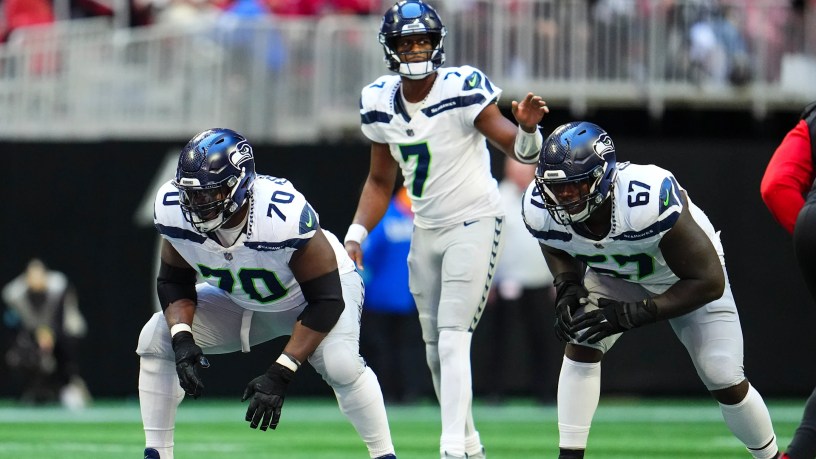
Image by Cooper Neill/GettyImages
Welcome to the Seattle Seahawks 2024 Season Review! This is the first of many season reviews that will be published by the Michigan Football Analytics Society this offseason. Even though I am from Michigan, Seattle has been my football team ever since Super Bowl 48 and the infamous Percy Harvin kick return. My favorite childhood players were part of the Legion of Boom, including Kam Chancellor, Richard Sherman, and Doug Baldwin.
Season Summary:
With a new coach in former Michigan and Ravens defensive coordinator Mike McDonald, expectations were relatively low for Seattle in 2024. Vegas had the over/under win total at 7.5 wins before the season. Even though Seattle did go over this win total with a record of 10-7, die-hards like myself consider the season a mild disappointment. Keeping in mind that the last two seasons have ended with identical 9-8 records and a Wild Card loss in 2022, this season felt like more of the same. After a 4-5 start, the team strung together four consecutive wins, leading fans to believe this season could be different. However, more of the same problems came back to light: the offensive line was manhandled in back-to-back losses to the Packers and Vikings, as did Geno Smith’s costly turnovers. Seattle was swiftly eliminated from playoff contention after a Los Angeles Rams win in Week 17 over the Arizona Cardinals. Many Seattle fans, including myself, believed the season may have gone very differently if Seattle hadn’t collapsed later in the season. However, there are avenues where the team can improve in 2025, which will be discussed in depth later.
Transactions:
The most important move of Seattle’s season was trading for linebacker Ernest Jones IV from the Titans in exchange for linebacker Jerome Baker and a 4th-round pick. Jones and rookie Tyrice Knight shored up the second level of the defense. From Weeks 1-7, Seattle was 24th in success rate and 30th in yards allowed against the run, and after Jones arrived in Week 8 through the remainder of the season, Seattle ranked 11th in success rate and 8th in yards allowed against the run. Jones is a must-sign for Seattle as he becomes a free agent this offseason.
Josh Jobe, who was a much more under-the-radar offseason signing, was another impactful transaction. Jobe was intended to be a depth piece for the team, but ended up starting most of the season after Tre Brown’s underwhelming level of play and Tariq Woolen’s injury. Jobe finished with seven passes defended and an interception in 11 games, while only allowing one touchdown in coverage. He cemented his role as an important depth piece in the secondary for Seattle.
Stats Breakdown:
The data visualization below compares the effective cap space and non-guaranteed cash in the offseason of every team.

Data Viz via Nick Korte (@nickkorte)
Even though Seattle is in the red for effective cap space, they can be extremely flexible this offseason. Potential cap-saving measures include cutting Tyler Lockett and Dre’mont Jones to gain 33 million as well as extending Geno Smith and D.K. Metcalf to save roughly 50 million in cap. Additionally, cutting Roy Robertson-Harris, Noah Fant, and Reyshawn Jenkins would save the team 21 million in cap. Those possible moves, in addition to the restructured contract of Leonard Williams,’ will grant Seattle flexibility to spend on free agents and draft pick signings.
The next data visualization shows the offensive and defensive EPA per play of every team.

Seattle was statistically positive in defensive EPA and negative in offensive EPA. However, Seattle’s company, next to the Pittsburgh Steelers and Miami Dolphins, is very telling of their output. Negative offensive EPA per play signifies inefficient production throughout the season; the primary culprit for this shortcoming is the team’s underperforming run game. Seattle was 28th in the NFL in rushing yards per game (95.7), due in part to Kenneth Walker’s injury issues and the offensive line’s inability to create rushing lanes for the backs. Seattle’s offensive line had a 69% run block win rate during the season, good for 28th in the league. For Seattle’s offense to become efficient, the offensive line needs to be retooled, and the scheme must improve under Klint Kubiak. More success on the ground will take the pressure off of Geno Smith and lead to shorter (and hopefully fewer) third downs. Positive defensive EPA was a pleasant surprise considering the defense’s very young core, which includes Tariq Woolen, Devon Witherspoon, Coby Bryant, Derick Hall, Boye Mafe, and Tyrice Knight. These players will only continue to improve under Mike McDonald. The primary issue with the defense is the lack of pass rush; there were multiple games during the season, including Green Bay, San Francisco (Game 1), and Buffalo, where the defense combined for one sack. Each of these games resulted in 30+ points allowed thanks to the extensive time to throw. Pass rush win rate must improve in order to force consistent pressure on quarterbacks and take pressure off of the secondary.
Personal Thoughts:
I believe that Seattle is headed in the right direction as a franchise, but in order to get over the hump, they must correctly address their issues in the offseason. Seattle has to invest draft capital and/or money in free agency on the offensive line. Some names to consider in free agency are Drew Dalman (C), James Daniels (G), Ryan Kelly (C), and Will Hernandez (G). In the draft, I especially like Tyler Booker (G), Grey Zabel (IOL), and Donovan Jackson (G), to name a few. I genuinely believe Seattle can easily win 10-12 games with investments in the offensive line.
Also, Geno Smith’s 3-year, $75-million contract is set to expire after this season. Geno wants to be paid like a top-ten QB, which would mean committing $40 million AAV. Seattle is set up with a manageable schedule in 2025, drawing the relatively easy AFC South for a cross-division matchup. Seattle hired offensive coordinator Klint Kubiak, who is aligned with Mike McDonald’s strategy after the team fired Ryan Grubb.
If Seattle can address the offensive line, figure out the quarterback situation, and Kubiak maximizes the offensive potential, they can be a dangerous team next season.
Conclusion:
Overall, Seattle’s 2024 season was more of the same for the fans who have watched this team for the last couple of seasons. However, there are ample reasons to believe that with the right moves in the offseason, Seattle can seriously contend for the NFC West title and a deep playoff run. Despite ongoing problems with the offensive line and inconsistent offensive play-calling, Seattle finished one game out of the NFC West. Calling all 12s, the future is bright!
 M-FANS